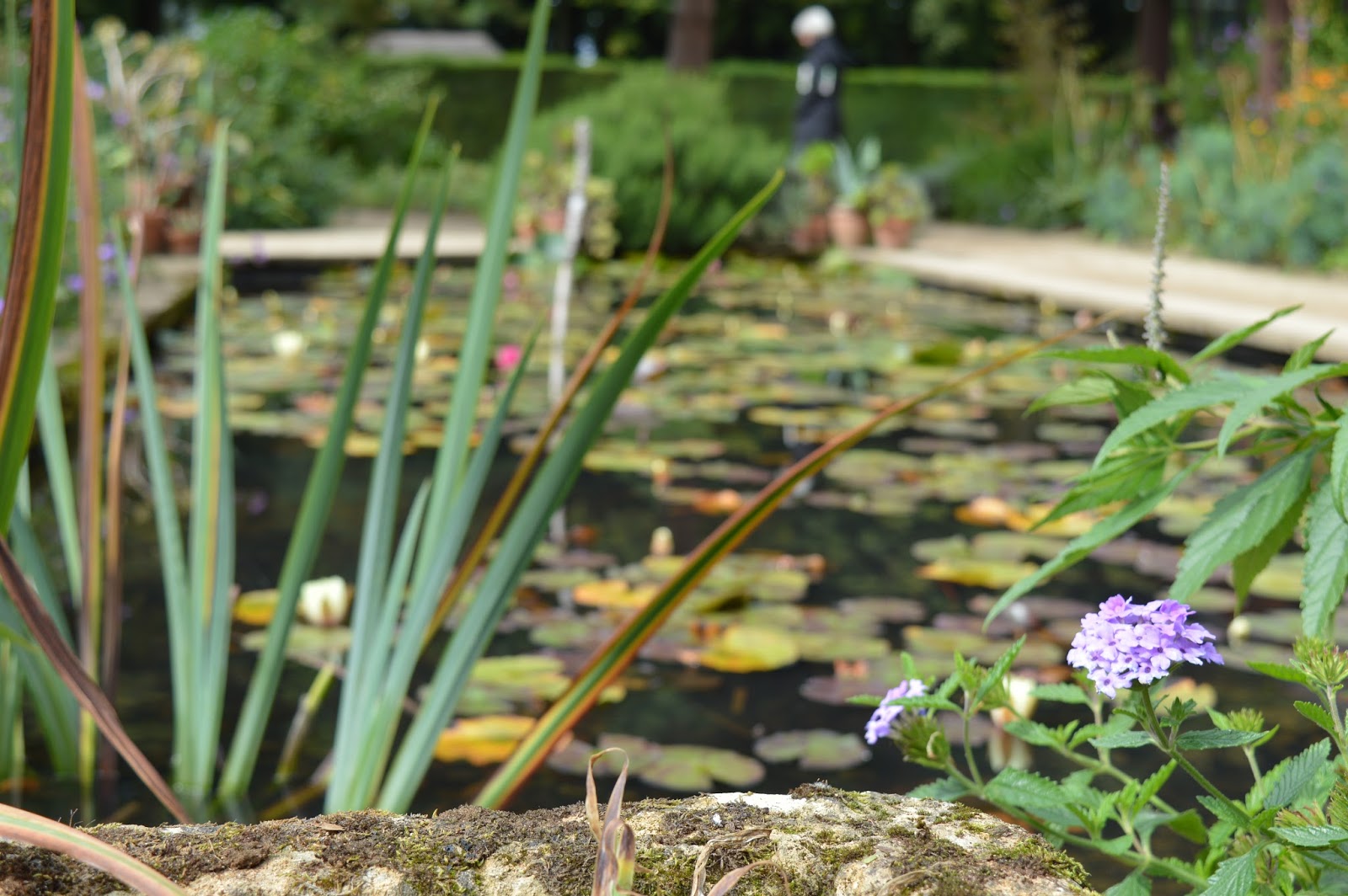
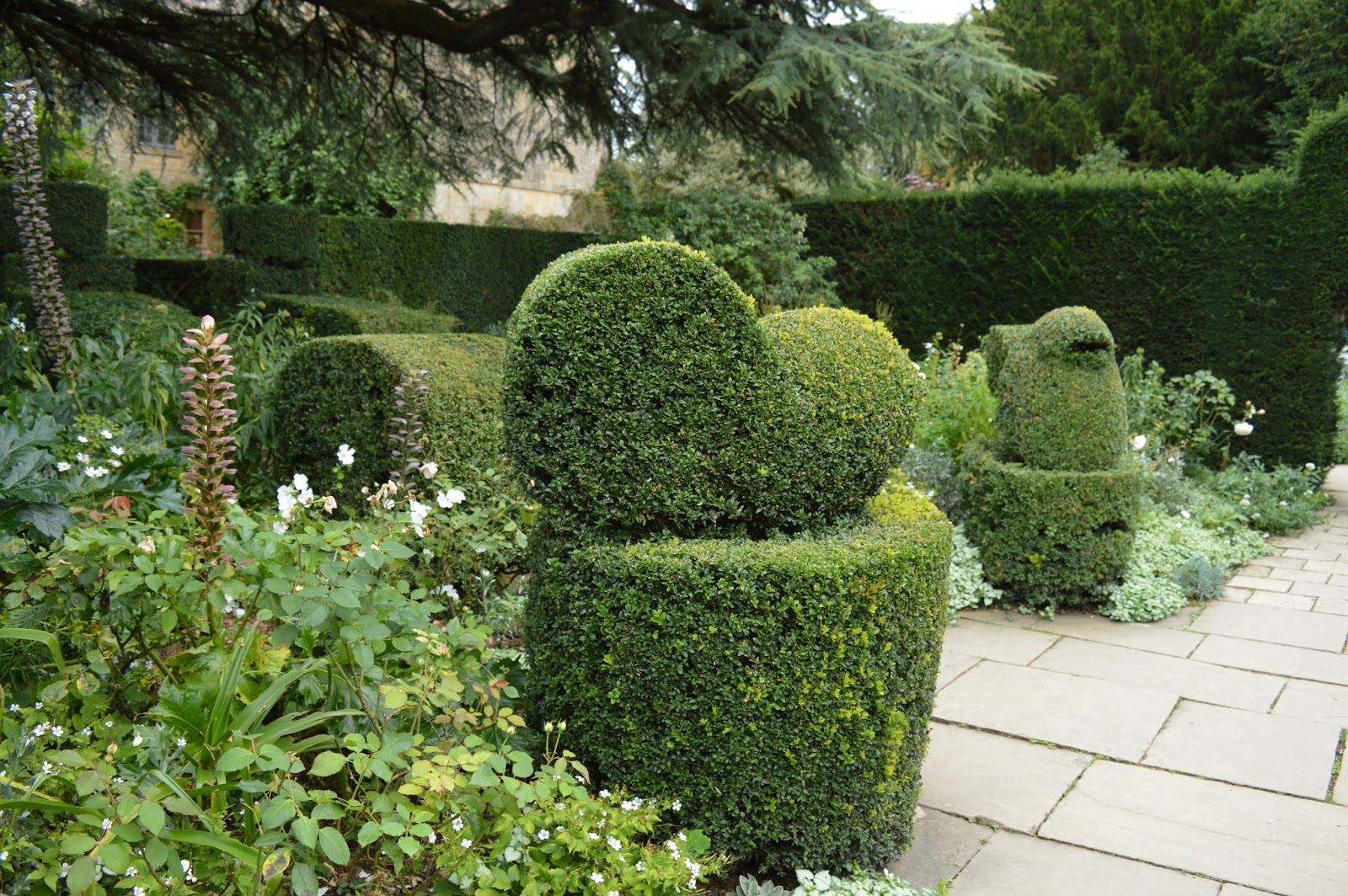
Cambridge Botanical Gardens
On a chilly but mostly sunny morning in March I set off Cambridge bound to see a lovely mate who I got to know through Twitter and honestly I'm so thankful I did! On this somewhat random occasion we'd chatted earlier in the week with a vague plan to meet up but no set idea of where we would end up, some of the best plans work this way I've found.
Pete had given me several options to choose from, there were many NGS gardens open nearby but given the chance and having never been there before I opted for the Botanic Gardens.
I've never even been into Cambridge that I remember, I might've when I was younger visited with my parents given how close it is to where I grew up and their propensity to drag us kids round market towns, Abbeys, old churches & suchlike but I honestly can't remember it. So we set off to find the town centre with a promise of the best cake ever & incredible plants.... I wasn't let down on both counts.
One word to the wise though regarding parking, don't!
There is a Park & Ride system operating and I was honestly shocked at how much we were charged for Sunday parking in a multi storey, yes it was convenient but if you can id still advise using the Park & Ride. Its less than a quarter of the cost of parking in the centre, moving on!
Cambridge itself is wonderfully photogenic, giving someone like me so many reasons to be a complete tourist. Apparently I wasn't the only one as even this early in the year it was incredibly difficult to get a completely clear shot. It was at this point I realised that even my usual foolishness had excelled itself and id neglected to charge my camera battery and although it had been reading over half a charge I was rapidly losing power, oops!
So after a few shots of the lanes and other amazing sights I stopped and saved the charge for the plants!
And so we reached the gardens, after an amazing long lunch with the most gorgeous cakes and a hysterical moment involving a waiter and a Tart...you had to be there.
I totally love Botanical Gardens, there's just something about growing a plant in the conditions closest to its natural environment that can be achieved, that challenge, and having all of the scientific information laid out before you that just gets me. Maybe it comes back to my time volunteering in Birmingham Botanical Gardens all those years ago, when I first started out? Maybe its the scientific element? I'm honestly not sure. I know I do love a good label though!
At the entrance I took the opportunity to buy "The Guide". This lays out in a colourful compact form the purposes of the Garden, its history and the plantings included. It will keep me happy to read this on many evenings to come.
 |
| View from West walk across the lake towards Henslow Walk |
We started meandering around the grounds, Pete being familiar, was my guide for the most beautiful views. Promising me "Trees with knees" we made our way up West walk and then onto Main walk.
There are some lovely well labelled spring pants as you move through what are mostly shrub borders up the West Walk.
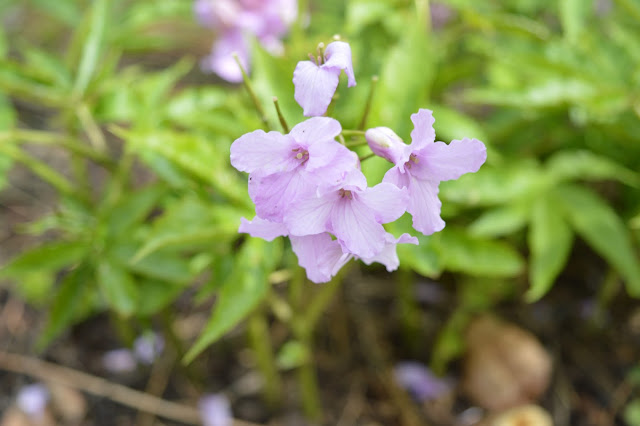 |
| Cardamine pentaphyllos syn. Dentaria pentaphyllos (five-leaflet bitter-cress or showy toothwort) |
 |
| Corylopsis spicata (winter hazel) |
As you reach Main walk there is an area given over to Redwoods
 |
Metasequoia glyptostroboides (Dawn Redwood) the living fossil
|
This rather unremarkable looking tree (above) is actually one, alongside the Wollemi pine, of the most exciting botanical discoveries of the last century.
Thought to be extinct and only known from fossil records right up till 1941, the name Metasequoia literally means "like a Sequoia" referring to its leaf shape. Professor T. Kan from the Dept. Of Forestry noticed it near a road in Mou-tao-chi, Szechuan province of China. The locals called it a 'Water fir' and it was incorporated into a shrine. Suffice to say this was botanically speaking a missing link and much excitement was caused worldwide by its discovery!
If you'd like to understand more about this trees history and botanical importance I found this amazing PDF produced by Arnoldia arboretum.
Arnoldia arboretum.harvard.edu - Metasequoia (Dawn redwood)
So when you see one of these enormous trees bear in mind that it can only be max. of 80 years old as it was totally unknown to the western world prior to that and seeds were only collected in 1947.
This tree though at Cambridge is extra special in the fact it was the first grown in England, being only a metre and a half tall in 1952.
Opposite it is the Sequoiadendron giganteum (Sierra Redwood) I know both these trees as we had them at Hole Park and that's where my appreciation of trees started. The bark of this tree is just lovely! Soft, spongy, its a cuddly tree! Yep, I know this sounds a bit mad but if you ever see one try it!
The first time I saw this tree was on a family holiday, we were at the Gardens of Heligan, traversing the depths of the Jungle with Echium pininana towering above us...
(I totally fell in love with those too, bought one, was warned it wouldn't survive in Birmingham. With the arrogance of the newly qualified, I totally ignored that and planted it out to see it get swamped by 2 Ft of snow that winter! It had grown to 6 Ft with a trunk the thickness of my arm, every morning for a week I went out and checked it but the damage was done. It rebranched, giving me 4 flower spikes that reached about 9-10ft. Not too shabby and made my neighbours ask questions! I digress though!)
... I had noticed this enormous tree towering above everything surrounding it and excitedly pointed it out to my dad, who up until then had been the tree authority of the family. "Dad! I think that's a Giant Redwood!" He looks up, squints, shades his eyes with his hand and says with confidence "No, its probably a Scotts Pine, you don't get Redwoods in this country". This conversation continued in this theme all through the bottom of the valley. I know my dad and to get him to acquiesce to ANYTHING you have to build a good reasoned argument and then prove it.
Incidentally this is the tree...
Heligans Redwood
So we climbed the slope of the valley up to the base of the tree, my bull headedness and my dads intractable nature, fully set to both be right, to see the name plate.... My dad to his credit took it with grace. Shock, surprise then delight crossing his face. A pivotal moment in the parent/child relationship, I'm not saying he always defers to me now but he at least listens a lot more.
Then at Hole park we had a specimen only 70-80 years old, enormous! The Sequoiadendron has many common names which does cause confusion, Wellingtonia, Giant Redwood, Sierra Redwood and sometimes Giant Sequoia. They're ALL the same tree.
Perhaps the most famous one though is General Sherman the largest of its type and estimated to be over 3000 years old.
Here's a link to some great facts from Kew...
Sequoiadendron giganteum - giant redwood
There's also the "Drive through" Tree, the Chandalier Tree. A redwood you can drive through. I found this cool Youtube video this guy took of him doing it... I apologise if I start over using the word cool at this point, if you watch the video you will understand why. Its just some Random guy who is driving around selling cars but actually he does a good job of documenting the surrounding area and the tree itself.... Pretty cool!
The vid is around 10 mins long and the tree itself starts at about 7 mins in but watch the whole thing if you have time.... Its totally cool...
Chandalier Tree video
On the pic below you can see a few holes a woodpecker has drilled into the bark, this bark is also a perfect substrate to wire epiphytic Orchids up to.
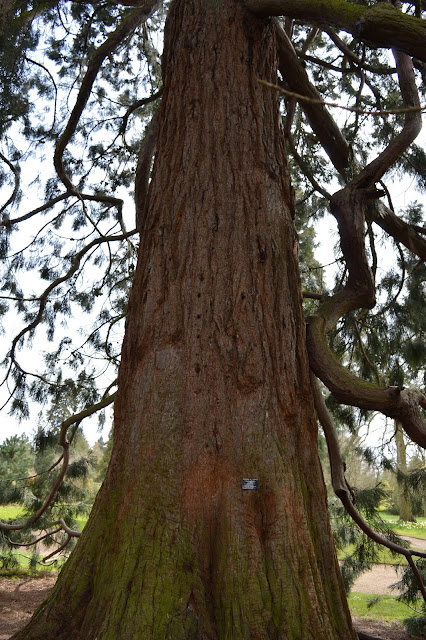 |
| Sequoiadendron giganteum |
 |
| Sequoiadendron giganteum |
We started heading down Main walk, past the "trees with knees" which it turns out are members of the
Taxodioideae family (as is the Metasequoia) which is a sub family of
Cupressaceae which has 7 sub families. Towards the rock garden which is located just beside the Glasshouses, approached via Henslow walk.
 |
| Paeonia clusii, found only on the islands of Crete and Rhodes (ssp. rhodia) |
 |
| Cherry trees in flower on the main lawn |
 |
| Cherry trees in flower on the main lawn |
Given the opportunity I will always head straight for the Glasshouses in any given garden, these are my "Glittery Fish". The place where the exotic, tropical, spectacular, often rare collections are kept. The Glasshouses themselves are wonderful creations built in 1860 and having undergone massive restoration works in the last five years.
They consist of a main corridor that connects 6 different environments and a 7th separate area the is dedicated to the plants that grew prior to flowers becoming a method of propagation.
On entering the corridor we were greeted by a gorgeous
Strelitzia reginae, native of South Africa but has successfully naturalised in many parts of the world that offer a similar climate. Interesting fact, they produce no windblown pollen, great news for those of you that suffer from hayfever, and are reputed to be pollinated almost exclusively by Sunbirds. First introduced to Europe in 1773 at Kew, a search reveals there is a hybrid called
Strelitzia kewensis (S. reginae and S. augusta) but the name is unresolved and very little information on it is available online. There is also a dwarf form available which is far more suited to a domestic situation.
 |
| Strelitzia reginae syn. parviflora (Bird of paradise) |
The first room in the Glasshouse which is called "Continents apart" houses the South African & Australasian collection.
 |
| Gasteria flower, commonly mistaken for Aloes are from the same family and look very similar |
 |
| Aloe plicatilis (Fan Aloe) only tree-aloe native to Fynbos habitats |
 |
polygala fruticosa (butterfly or sweet pea bush)
|
This native (above) of South Africa has literally driven me mad, this plant alone has taught me to ALWAYS take a picture of the label! Ive only ever seen it 3 times previously. Once in Barcelonas Botanical gardens, once at Sissinghurst and once in a cafe in Rhodes (absolutely gorgeous cafe stuffed with beautiful plants!). The 2 times I saw it with the label at Barcelona & Sissinghurst I thought to myself "i'll remember that".... didnt'..... with the one at Sissinghurst I cockily thought "well i'll always be able to come and see it if I forget"... moved to a new job.... Lesson now thoroughly learnt!
I also learnt another fact checking lesson on this trip which I won't forget in a hurry but i'll get to that in a moment...
 |
| calothamnus rupestris (mouse ears or cliff/granite net-bush) Myrtacea family endemic to S.W. of Western Australia |
 |
| Callistemon spp. possibly citrinus or viminalis, no label available (Bottlebrush) |
 |
| kennedia rubicunda (dusky coral pea) is as its common name suggests a member of the Fabeacea family, climber. |
 |
| Aloe ferox (Cape aloe) |
 |
| Aloe ferox (Cape aloe) |
 |
| Cordyline stricta flowers, syn. Dracena stricta. |
And so room one completed, sufficient "ooh's" & "aah's" given we returned to the "Corridor of Delights!"... Ok thats not its official name but it should be.
First to catch our eye was this delightful and delicate climber from the Canary islands, such an unusual colour.
Then very quickly my eye was drawn to what at first glance looked like a giant
Ageratum! (it wasnt of course!) Standing as tall as me, so not that tall, just over 5ft and festooned with fluffy lilac powder puffs the size of my hand. The leaves are covered in a soft down too. We scrambled round underneath for the label, it was a Eupatorium! Ive grown
Eupatorium purpurea in my own garden before its lovely and completely hardy but this Mexican export is something special,
Eupatorium atrorubens.
Strangely though there was very little information available on this plant online, so a quick search on this plant came up with an entirely different name for it,
Bartlettina sordida, not quite so pleasant a name. Apparently though this is the current classification according to the internet. Its considered an invasive weed in Australia & New zealand, this makes me wonder if this was the plant my mum described as a large
Ageratum when she returned from Aus. after visiting relatives?
Ive left it labelled below as Cambridge Bot. Gardens has labelled it although there were a few occasions whilst looking around I did wonder how often they checked their own labelling as I came across a few that seemed a bit ...odd?
 |
| Canarina canariensis (Canary Island bellflower or Bicácaro) |
 |
| Canarina canariensis (Canary Island bellflower or Bicácaro ) |
 |
Eupatorium atrorubens (thoroughwort/purple torch/blue mist flower)
|
 |
Eupatorium atrorubens (thoroughwort/purple torch/blue mist flower)
|
Into room two, this is described as being the Oceanic Islands, so includes a lot of plants from the Canary Islands. Below is
Echium hierrense, this rare
Echium species is found growing only on the Canary Island of El Hierro.
This plant beautifully demonstrates what I was saying in my previous blog, I can find no common name for it due to its rarity. You may have noticed that on all my pics ive been including the common name/s in brackets, some have 2 or 3, most confusing! Common names are fun but they are just nicknames not
real names...Ok soapbox moment over!
 |
| Echium hierrense (no common name known) |
Below is a totally lovely
Euphorbia but sadly we couldnt find its label, a real shame. The
Euphorbia family is MASSIVE! I remember from my Taxonomy course at Oxford being shown 2 books one was basically a pamphlet that was the Ginko family, the other was a tombe of magnificent proportions. Easily 4 inches thick, this was all of the known
Euphorbias!
So, I thought I'd be clever and Google search "
Euphorbia Canary Islands", I'll cut the suspense, the answer was no. The
Euphorbia canariensis is what most people would think of as a cactus or succulent type plant. There is a possibility that its
Euphorbia balsamifera but I'm loathe to say this for definite.
Then back to the "Corridor of Delights" for a Calistemon, this one below is the one you see most commonly grown in the UK and my Dad had one growing as a standard for several years near Durham till the wind snapped it and in a fit of pique he threw it on the compost without taking cuttings. I shall say no more on this matter....
 |
| Calistemon citrinus var. splendens (Crimson Bottlebrush) |
Into room 3, this is the Mountains environment. Previously known as the Alpine house, includes many of the beautiful little specimens you would expect but also held a few surprises for me.
 |
| Saxifraga sempervivum (no common name) |
Particularly a Pleione, a type of Orchid reffered to as the Peacock Orchid. I'm not sure why I always think of Orchids as growing in hot, humid jungles. A lot do but equally we have several species in the UK which grow predominantly in grasslands and one almost mythical species with the romantic name of the Ghost Orchid,
Dendrophylax lindenii .
Heres a link to the site otherwise I'll wind up going completely off topic again...
Ghost orchid project
Back on track, I checked up on the name given for this Pleione ('Vesuvius') sadly it seems its not entirely correct. I even went so far as to ask Twitter and had a few Orchid experts respond. Apparently its very prone to crossing so although it may have been acquired as one variety it seems its not but also im unable to pin down what it is exactly but a rose by any other name... or Orchid...etc.
Pleione Vesuvius is a cross made by Ian Butterfield and was registered in 1978 (Pleione bulbocodioides x Pleione x confusa) but this is not Vesuvius.
Plieones natural habitats are the foothills of mountain ranges in as varied places as the Himalayas, India, Tibet, Nepal, Bhutan, Bangladesh, Burma, Thailand, Laos, Vietnam and China.
 |
| Pleione 'not Vesuvius' (Peacock Orchid.) |
 |
| § Rhododendron rarum (no common name) Papaya New Guinea |
 |
| Primula x pubescens 'Verity's violet' (Garden auricula) |
Whenever I see the
Corydalis shanginii subsp. ainii, below, my head insists on singing the theme tune to the 'Banana splits' (showing my age!). This is a tuberous plant from Kazakhstan, there is very little online information on this plant so I'm afraid thats all I can tell you.
 |
| Corydalis shanginii subsp. ainii (no common name) |
 |
| Corydalis shanginii subsp. ainii (no common name) |
 |
Tulipa humilis var. pulchella 'Albocaerulea Oculata' (No common name)
|
 |
| Tulipa acuminata (Horned tulip) of Garden origin first recorded in 1700's |
 |
| cyclamen persicum (No common name) parent to the Florists Cyclamen, native to Turkey |
 |
| cyclamen persicum (No common name) parent to the Florists Cyclamen, native to Turkey |
 |
| Corydalis solida syn. C. halleri, C. transsylvanica (solid-rooted fumewort) |
It may be worth pointing out at this juncture that Latin names are not infallible as you will sometimes see (as above) the qualifier 'Syn.' after the Latin name. This means that the plant has for one reason or another been known at some point under another name. This plant
Corydalis solida was first named way back in 1753 by Linneaus who called it Fumaria bulbosa 'Solida' . It was then reclassified in 1771 as
Fumaria solida by
Philip Miller.
To further confuse and blind us with science it was reclassified in 1811 to the Corydalis genus where it has remained since by
Joseph Philippe de Clairville
Its worth understanding though that these name changes are not for fun and have a basis in science and furthering our knowledge and understanding of the plants origin and lineage. Each time a name is changed its because some new discovery has been made about it. These revisions eventually lead back further in time to the common ancestor and help us understand not only how a species evolves but also how our world has evolved.
 |
| Saxifraga 'South down star' |
Above 'of garden origin'
Saxifraga
 |
| Melasphaerula ramosa (no common name) |
 |
| Melasphaerula ramosa (no common name) |
This lovely little member of the Iridacea family has given me a bit of a headache in some ways.
Melasphaerula ramosa it seems has many synonyms and very little information online other than it is native to Namibia & Cape province. It is also the only Species in the Genus
Melasphaerula but confusingly, for me anyway, it seems to be quite variable in its flowers appearance? This may require a bit more looking into for me to understand...
Synonymy
- Gladiolus ramosus L. , Sp. Pl .: 37 (1753).
- Phalangium ramosum (L.) Burm.f. , Fl. Indica, Prodr. Fl. Cap .: 3 (1768).
- Gladiolus gramineus Lf , Suppl. Pl .: 95 (1782).
- Diasia graminifolia DC. , Bull. Soc. Philom. Paris 3: 151 (1803).
- Diasia iridifolia DC., Bull. Soc. Philom. Paris 3: 151 (1803).
- Melasphaerula graminea (Lf) Ker Gawl. , Bot. Mag. 17: t. 615 (1803).
- Melasphaerula intermediate Sweet , Hort. Brit .: 399 (1826).
- Parviflora Melasphaerula Lodd. , Bot. Cab. 15: t. 1444 (1829).
- Melasphaerula iridifolia Sweet, Hort. Brit., Ed. 2: 502 (1830).
- Diasia intermediate Heynh. , Nom. Bot. Hort .: 261 (1840).
- Diasia parviflora (Lodd.) Steud. ,. Notes Bot., Ed. 2, 1:. 501 (1840)
 |
| veltheimia bracteata (Forest lily/ Sand lily/Red hot poker - not to be confused with Kniphofia) South Africa |
veltheimia bracteata is an interesting
example of how common names can get in the way, one of its common names is Red hot poker. This, I suspect for most of you would conjure up images of Kiphofia's, yes?
Totally unrelated, sorry.
It is one of two distinct plants in this Genus, the other,
capensis refers to the Western Cape Province of South Africa where it is endemic. Whereas
Veltheimia bracteata is native to the south-eastern Cape Provinces of South Africa. The two can interbreed though if grown together.
The incredibly rare Fritillary below is a threatened species from the Greek Islands
fritillaria tuntasia
 |
fritillaria tuntasia (no common name)
|
 |
fritillaria tuntasia (no common name)
|
Just judging by how many pictures I took at this stage I'm guessing you've realised I'm quite partial to the odd alpine plant, yep ok I admit it.
Unfortunately, for me, this was the point on my tour that my camera battery gave up the ghost! Trust me I was kicking myself, especially when I saw what was coming next... but thankfully I had my trusty phone with me and although it was running low as id used it as a Sat. Nav. earlier in the day (seriously, how did we survive before the invention of smart phones? I will never be one of these people who shun technology, my only problem is keeping up with it!) it saved my bacon....again!
So my last pic of the Mountain display was of this beauty below.
 |
| Moraea loubseri (no common name) |
On to the next environment that has been so carefully laid out by the people at Cambridge, this is what killed me about my battery dying, a particular love of mine. The Tropical Rainforest enviroment. We were greeted by a huge variety of Passiflora species, Orchids, Ficus and Thunbergia. Vines criss crossing the ceiling, the humidity which I adore but my hair hates. I was like a kid in a sweet shop!
Bear with me, we're on the home strech here people!
I turn the corner and let out a squeal, unnerving a lovely couple nearby, you see I'd recently come across a must see plant for my bucket list. I say recent, 5 years or so is recent, right?
Before me lay the beautiful, wonderful
Strongylodon macrobotrys, otherwise known as the Jade vine. Id recently read a peice at Liverpools Croxteth Hall flowering vine that apparently hadn't flowered for 40 years!
Liverpool news watch rare plant flowers
The article doesnt say why it hadn't flowered for so long? Maybe cultural conditions weren't right? Its a native of the Phillipines so maybe they werent able to replicate the conditions needed until now or maybe its just been so supremely happy growing there it didnt feel the need to try to reproduce until now?
Even at Kew though they struggled to get a flowering plant to produce viable seed until 1995, Pete my guide offered up a little gem of information on this one. In its native habitat bats would be key to pollination. Obviously in England this option isnt readily available but apparently rats are capable of successfully replicating this system. Hand pollination though is the more normal method of producing viable seed, Chrissie Prychid at Kew used hand pollination to get the jade vine in the
Palm House to make pods for the first time in over thirty years.
There are several of these marvellously otherworldly plants in the UK, Kew, Cambridge and Eden as well as Croxteth Hall's and I'm sure there are more, as yet unknown to me .
 |
Strongylodon macrobotrys (Jade vine)
|
 |
Strongylodon macrobotrys (Jade vine)
|
 |
Strongylodon macrobotrys (Jade vine)
|
 |
Strongylodon macrobotrys (Jade vine)
|
There were absolutely masses more interesting and worthwhile plants worth talking about but I fear I may have talked quite enough already! So I shall leave you with a last two amazing ones. Hopefully this will inspire you to visit yourselves!
Also in the Tropical Rainforest enviroment was this gem,
Clerodendrum thomsoniae
 |
Clerodendrum thomsoniae (Bleeding Heart Vine or
Glory Bower) |
Clerodendrum thomsoniae, native to tropical west Africa from Cameroon west to Senegal. The sweetest thing perhaps about this plant was it was named at the request of Rev. William Cooper Thomson (1829-22 March 1878), a missionary and physician in Nigeria, in honor of his late first wife.
It was a popular during the 1800's under the name "beauty bush" but the knowledge of how to grow it successfully was for some reason lost, so it became seen as a "difficult" plant. In reality its needs are actually simple, its root system needs to be submerged in water for a good proportion of the year and it needs good light.
and finally, my ultimate lesson for the day!
Below is
Petrea volubilis syn.
Petrea kahautiana,
Petrea arborea,
Petrea aspera or common names are Queen's Wreath, Purple Wreath, Sandpaper Vine, Bluebird Vine.
and my lesson was... Never, ever tweet without fact checking first! I was very lucky that the correction was extremely gently worded and I was very grateful for it.
To be fair I normally do fact check but on this occasion I blythely went with the label at the base of the plant which if I'd stopped for even a second and thought about I may have realised was a little off! The label confidently announced the plant was a member of the Legume family (its clearly not). When I first started learning nomenclature this family was still being referred to as Papilionaceae(ie: like a butterfly) this then changed to Leguminosae (ie: like a pea) it now, to my knowledge has changed to Fabaceae as they have found through DNA testing that it is a Monophyletic group.... wait....I'm going off track again!
Heres a link that explains it better than I do
Fabaceae
So, back on track,
Petrea volubilis is native to South America's lush tropical rain forests but can cope with a few cultural stresses
. Making it a popular shrub in a more domestic situation. I dont think I've ever encountered a plant with more synonyms!
36, that I counted!
Its also been introduced very successfully to parts of Western Africa.
 |
| Petrea volubilis (Queens wreath) |
 |
| Petrea volubilis (Queens wreath) |
 |
| Petrea volubilis (Queens wreath) |
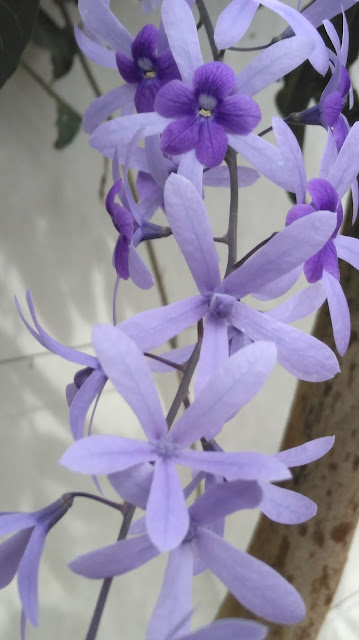 |
| Petrea volubilis (Queens wreath) |
I havent covered the remaining rooms in the Glasshouse or even touched on the grounds themselves either historically or planting wise, maybe I'll come back to that at a later date?
If you are curious though yourselves Cambridge have a rather lovely website thats full of information and for the user works really well.
Cambridge Botanical Gardens
I would highly reccomend a visit though!