Showing posts with label border. Show all posts

Thursday, 22 September 2016

Hidcote Gardens - Rooms with views


Mid September, a time when the garden is starting to wind down and the garden visits for the year are slowing. I couldn't resist saying yes to the All Horts gathering at Hidcote though. It's a garden I've loved for many years. The last time I visited was shortly before I left Garden Organic and moved south, at that time we were lucky enough to go on a staff visit and get a tour from the, then Head Gardener Glyn Jones. Glyn has now left to make a mark on the historic gardens at the Shakespeare Birthplace Trust, Stratford-Upon-Avon.

My last visit was roughly 10 years ago, give or take, Hidcote had been a regular on my list of local gardens, one that I had taken Mum & Dad to visit. Sadly I don't think I have any pictures from back then but in my head the gardens were always sun baked and peaceful, my favourite border was always the famous red border, so even though I set out early in the morning in rainy gloom I was feeling optimistic for the forecast.

Lawrence Johnston was the originator of Hidcote, starting in 1907, his mother bought the manor house and he set about turning the surrounding fields into what is now an iconic garden in the Arts & Crafts style. The theme of the "Garden room" is not as new as the glossy magazines would have you believe, Plantsmen of the early 1900's had already started this trend of areas enclosed and themed with exits and entrances leading to wonderful vistas over surrounding countryside.


His influencers, such as Gertrude Jeykell & Alfred Parsons are now bywords for excellence in design. His peers and contemporaries were people such as Norah Lindsay & Vita Sackville West, known for her creation of Sissinghurst. Lawrence Johnston was a quiet man by all accounts far more at home creating his gardens than the life of a 1920's socialite, maybe that's why Hidcotes name is the one people remember rather than his? In the world of botany though this man was a giant! One of the unsung heroes of plant hunting, he went on plant hunting expeditions to Europe, Asia, Africa, China and South America. Each time bringing home a small gem for his gardens. He was also a great sponsor for other people, making it possible for Frank Kingdon Ward to travel in Burma, one of the people responsible for introducing countless Rhododendron species. W. T. Goethe & Edward Augustus Bowles travelled with him. Highly influential in every way, this quiet man bequeathed Hidcote to the National Trust in 1948 when he retired to his garden in France Serre de la Madone.

Back to present day!
Bearing in mind several points...
I haven't seen the garden in around 10 years
I never saw it this late in the season


The approach to the gardens has changed massively from what I remember, there is now a lovely new build (?) cafe and plant sales area. The signage around this area is pretty good I noticed as I rushed to try and catch up with the others. The entrance completely threw me out! Same gateway but now you enter through the entrance of the house itself, which is quite nice. I say this is a new thing but in reality I don't actually remember exactly how it used to be? I think it was through what is now a gift shop, anyway!


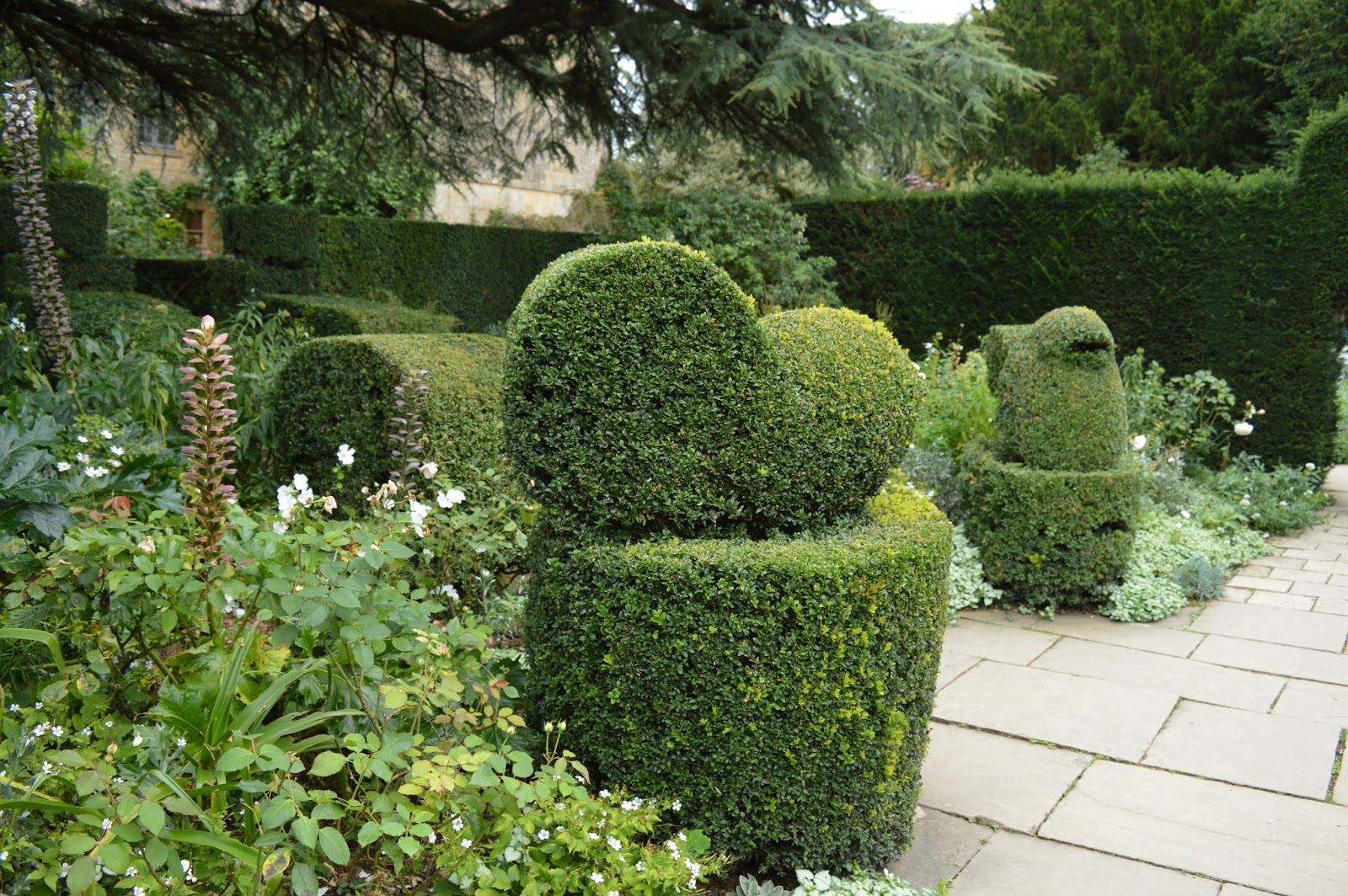
The first sight as you enter the garden is of a cute little parterre with an excellent choice as an alternative to box hedging, Euonymus fortunei 'Emerald Gaiety' planted up with summer bedding of Salvias and what I think are Bidens (I could be wrong on this, I was in a hurry) Rocky and I were almost an hour late, traffic, so we scurried to catch the end of the tour being kindly led by Sarah Davis the Assistant Head Gardener. Flying past the enormous Cedar of Lebanon I remembered the last tour I had been on before being surrounded by a fantastic scent of cherry pie! An entire bed of Heliotrope that even on this overcast day was able to envelope you with its mouth watering scent. I caught sight of our group, in the distance, and tried to negotiate the straightest path to them. This as it turned out included naughtily leaping some of the Trusts iron hurdles to gain access to the sacred Red Border where our group of intrepid gardeners were being treated to a private viewing! Quick introductions were made to those members I hadn't met before, hugs for those I had, a few pictures and then on to the plant house.


Talking mainly about the history and much needed restoration of the relatively recent addition (restoration?) of the wooden conservatory called the plant house. Sarah explained how only 10 or so years old it is already needing a lot of work to its wooden supports to keep it in good repair and the decision on how to fund this work is very much in the forefront of everyone's minds. Its such an important aspect to the garden not only in its history but also as a place to house and show some really gorgeous plants in their collection.


From there we moved to the long borders, an area I'm sure had only been recently planted up when I last visited, I wish I had managed to arrive on time. I could've asked more questions! They were just at the point of going from summer splendour into autumnal tumble. Still verdant with jewels of Asters shining through, just a hint of winter structure from the seed heads and exclamation points provided by the carefully manicured hedges.

We moved through to the Kitchen Gardens which had changed beyond all recognition for me, my last visit this area wasn't open to the public. It was an area like most gardens have, a graveyard of old pots, scruffy plants and dead machinery. Now fully in use as a Kitchen garden with a late crop of runner beans handily planted to the side of the path a quick taste test ensued.... they were lovely!

At this point our lovely guide took her leave and we headed for the cafe. I wont bore you with the details of what I ate but it was lots and it was lovely. We chatted and caught up with one another then headed over to Kiftsgate, this is where it gets funny...


We posed for our usual "All Horts" picture, as ever ably taken by Gerald, by the gates. We even looked at the signs with opening times and admission prices before ambling through the gates and up the long driveway. We perused the plant sales area and enthused over the Salvias when a deep baying ensued.


Release the hounds!

Hush puppy!


Introducing the resident Basset hound!

Somehow each and every one of us had failed to notice the massive signs at the entrance saying CLOSED ...oops!

Rocky singing the rusty gate song... F sharp?


So having failed in our mission we beat a hasty retreat back to the cafe at Hidcote to renew ourselves, chat a bit more, then myself and a few intrepid others went back to revisit areas of the garden we had missed on our whistle stop tour.


On reflection, the elements that make Hidcote, Hidcote are all there, no matter the season. The thought that was put into its vistas, the quiet areas, even the wonderful paving that changes throughout the garden to reflect the theme. Hidcote is undergoing some major renovations, replanting, but the ethos that Lawrence Johnston built the garden to is evident at every turn. 

"Plant only the best forms of any plant"


Sunday, 27 March 2016

Auriculas part 3, Alpines, Doubles, Borders & Seeds

Hi again!

So its been a few weeks since i posted, Birthday treats got thoroughly in the way! Im so not complaining, Ive been spoilt rotten. Just to brag for a moment, it started off with pizza & then I went to see Monet's Triptych and lots of other garden related art (brilliant and moving) then was treated to a Willy Wonka themed High Tea that had Umpaloompa cakes, pink Champagne and a Golden ticket (so spoiled!). The wonderfulness continued with more Champagne and a great turkish meal (my favourite!) and was rounded off by more pizza. All completed with the most amazing company of quite frankly some of the most awesome, generous, thoughtful people im lucky enough to have in my life!
Then i spoiled myself by visiting the Linnean Society for the first time to hear a lecture on the life and works of an incredibly inspiring lady called Marianne North. She travelled the world painting plants in their habitats at a time when it was considered incredibly unseemly for a lady to do so, for this reason alone i adore her! I have never been incredibly good at conformity, ive tried and failed and as such i admire anyone who has the ability to forge their own path. They inspire me to carry on being me and not to try to hide my light. As an aside, and quite honestly a shocking treat, as i was walking up the stairs of this magnificent and historic building where Charles Darwin first put forward his 'Origin of the species' thesis i looked up at a gentleman coming down towards me. He looked incredibly familiar and knowing my awful ability to forget people ive met and talked to i erred on the side of caution, i nodded and said hello with a smile, still puzzling where id met him before.
I joined a large group of people in the Library, a magnificent room which is worth revisiting, and proceeded to chat to a lovely man called Tom, there was no one i knew there and we were stood beside a couple of ladies when the gentleman i saw on the stairs approached the group, then i heard the voice!
Like a memory of childhood and fascination this voice like silk rolled out and suddenly the penny dropped!
I was stood next to Sir David Attenborough!!
Even writing this now i cant get over this... He was showing the lady a copy of a watercolour that he believed was possibly by Marianne North and being the cheeky mare i am, i firstly eavesdropped then turned and peered over the shoulders. The lady turned out to be Michelle Payne who was giving the lecture.
Im afraid i did waylay Sir David and his daughter on the stairs on the way down to gush at them. They were both absolutely lovley about it given there was this mad lady babbling at them! I sat myself in the seats with them in the row ahead of me and settled down to listen, afterwards i got myself a copy of Michelles book and had her sign it.
I can highly recommend living a life of saying "yes!" as i have now since Jan 2014, it works out splendidly!
Now back to auriculas...

 So, a quick recap of whats gone before...


Part 1, Me enthusing on how i fell in love with these enchanting little plants.

Part 2, A short history inc. ancestry and an introdution to the technical terms used when showing auriculas plus an outline of the classes of show auriculas.

and now onto Part 3, comprising of Alpine, Doubles & border auriculas. Also a guide into how to care for these incredibly forgiving plants, dainty and fragile they may appear but dont let that fool you. These guys came from hardy stock and will withstand a lot!

Alpines

The main difference, to the amatuer, between an Alpine and a Show auricula may not be obvious at first glance. So here it is, the eye of the pip (flower) including the tube should be all one colour. Also there should be no evidence of Farina visible.
One of my own seedlings, classed as an Alpine but not show quality
Using one of my own seedlings, above, as a demonstration you can see the eye although beautifully clear white, with no sign of Farina, unfortunately has a yellow throat (or tube). On the older flower, at the top of picture, although the throat has turned white the colour from the petals has bled into the eye. The anthers clearly prominent are exactly what we want in an Alpine (Thrum eye) but sadly the colour of the eye and tube let it down and it would never win a show.
A true winner of an Alpine class looks like this....
   Best Alpine Auricula ANDY COLE grown by T Atkinson
As you can clearly see the eye is of one colour, clean pure white in this case although this can extend to a pale cream and still be acceptable (light centered). Alternately a deep rich, buttery yellow is also acceptable (gold centered) anything in between is seen as an inferior example and although i would still love it, it would never win a show.

Alpines, like Show auriculas, have subclasses which i'll outline below.

Light centered & Gold centered

As ive gone into this in detail above no need to thrash the point but here is a visual demonstation of a Gold centered Alpine winner.
Gold centred Alpine Auricula BANTRY BAY, pic credit  David Underwood

Laced

Im not really going to go into this in detail as it seems to be a relatively new class and from what i can tell is more about Polyanthus than auriculas? I could be entirely wrong? If i am please let me know.

Fancy

Again a relatively new class, this one gives the Alpines that dont fall into the above catagories a chance to shine. Not all shows run with a fancy class but if your local one does you can be assured of some really beautiful, interesting plants. The plant should conform to the above Alpine standards but leeway on the colour of the throat is allowable as is patterning of the corolla.
Fancy Alpine Auricula HERMIA.Shown by Andy Thorpe.Photographed by Henry Pugh


Knowle April 2012

Doubles

As i mentioned previously Double auriculas were almost lost entirely to cultivation. In the 17th Century they were the 'must have' addition to a collection. Thankfully though some dedicated breeders reserected them and they are now quite widely available again (including the beautiful 'Miss Sibsey') One such breeder from the 1950's was Florence Bellis. She is famed for developing the 'Barnhaven primroses' named after her Oregon home. More information on this fascinating lady and her writing can be found here timberpress author Florence Bellis and of course her nursery which supplies auriculas named Barnhaven from whom i have bought some lovely plants before.
So! Doubles!
The standards say " The minimum doubling needed is a row of petals (two in Northern Section shows) and enough additional petals to fully cover the centre. Open centred plants are disqualified.
All types of auricula that possess the required doubling are acceptable. Petals can have any patterning but should be smooth and unnotched and colours should be bright."

I think that covers it comprehensively, basically 2 or more rows of petals, no open centres and all subdivisions (show, alpine and border) can be included in a Double class.
From Matt Mattus's blog, link at bottom of blog

From Barnhaven, Primula auricula 'Lincoln Melody'. A stripey double produced by Derek Salt.
and of course my very own favourite 'Miss Sibsey'

Border

Our final look is at Border auriculas, these are the ones you would, as the name suggests, plant out in your borders. Despite the auriculas delicate looks they are in fact completely hardy, the only thing theyre not really keen on is having soggy feet (who is!). The Border class of auricula is far more forgiving and allows for a lot more leeway than any of the others.
The basic rules are the flower truss should be unstaked and preferably multi trussed. Florist rules do not apply to the border, pin eyes are acceptable, colours clear and bright.

Seed sowing

 Growing your own from seed is amazingly easy (honest) the seeds are readily available through either the larger companies or, if your looking for a show stopper, some of the more specialist companys and breeders will do mixed packets.
All you need is a seed tray, i normally sow straight to modules but as the seeds are SO small a small tray is better. I tend to use a seed compost with a lot of grit mixed in as the base. Mix the seeds with sand as this will help you see where youve already sown and mae it easier to space them out. Then you can cover VERY lightly with either more seed compost, Perlite or my preference Vermiculite.
They dont want to be deeply buried, just enough to retain some moisture. Then cover with either a seed tray lid, if you have one, clingfilm works too as do those plastic boxes that caes come in from the supermarket (be inventive, youre helping the environment by recycling them!). If you have a sheet of glass thats great too! Germination can be slow, so be patient. Ive left mine in seed trays for around 2 months to allow those that have started to bulk up enough to be potted on, then replaced everything under the glass and more have germinated. No one told me how to do this, just trial and error, others may have a different view.  This is the beauty of gardening though, just do your best to mimic the optimal conditions the plant would encounter in its natural environment.

I hope you try out some of your own, maybe even enter a show? or grow some from seed?
This ended up being a far larger topic than when i initially started posting on it and honestly theres so much more i didnt cover but on my way heres some of the links i found....

growing auriculas for beginners
THE NATIONAL AURICULA & PRIMULA SOCIETY NORTHERN SECTION
Barnhaven auriculas

Whilst researching i also came across these wonderful blogs
The auriculas of spitalfields
How to grow auricula primroses

Anyone ive missed in the last 2 blogs feel free to put your names and links in the comments box (there should be one located at the bottom of this blog). I look forward to hearing from more of you Auricuphiles, is that a real word? or one ive just made up?